FreeBSD vs. Gentoo
FreeBSD and Gentoo are both acceptable operating systems in my book, but they both have their weak and strong points. They both have excellent speeds, so you're not going to see any tedious graphs of how much faster Gentoo can convert a .gif to .png on this page. If you see an interesting term in this article and want to find out more about it, google it, I'm not about to spam the page up with a bunch of links either.
FreeBSD wins hands down. It's not even a competition. Sysinstall on FreeBSD is the easiest thing to setup, and I can get a copy of FreeBSD installed and into command line in under fifteen minutes. Gentoo's suggestion for installation is archaic. They made a livecd that will install Gentoo in a text mode of GUI, but it really does take longer than FreeBSD and it really did screw up a couple times.
I have no clue why, but the Gentoo partitioning step wouldn't let me have a FreeBSD partition. It refused to install because it said my FreeBSD partition was "Unknown" and this somehow matters to them. So I deleted FreeBSD since it was only a snapshot, and let Gentoo install. Windows didn't want to boot after that. The second time through the livecd I was able to get a Grub setup where Windows and Gentoo stopped fighting and let the other guy boot, but it was pretty inconvenient. If you want an easy install, FreeBSD will be best, and I honestly prefer the FreeBSD boot manager to Grub.
I'm sorry, but FreeBSD again. Five minutes into Gentoo and it's already spitting error messages at me about port overlays, masked packages, updating configuration files for emerge, it just went on and on. All I wanted was 915resolution for my widescreen monitor and it says "Masked package" when I try to install it. Well that's cool, but I need it for X. Why is it even masked in the first place? I never had this problem with FreeBSD, the port worked and everyone was happy. If they knew it wasn't going to work, it wasn't in the ports in the first place.
Sound. Alsa blows. Here's my sound setup on FreeBSD.
kldload snd_hda
The sound works perfectly at this point. Multiple programs can play sound at once and I'm happy. On Gentoo, I emerged the alsa-plugin, attempted to setup dmixer, kept screwing around with it until I eventually got sound working. Okay, but now every time I try and play more than one sound, the second program won't play. What is this? My soundcard /dev/dsp is already in use? What should I do now? Setup a ~/.asoundrc? Is it so hard to just make a sound system that can play more than one sound by default? The solution for this problem sucks anyways, I have to type aoss in front of every application that uses sound just so it can share the soundcard when I run them.
FreeBSD's startup applications are easier to set too. Basically if I want Apache2 on startup, I add the line
apache2_enable="YES"
to /etc/rc.conf and everyone is happy. Usually the port tells you to add this to your rc.conf after it is done installing, so there are no problems. The Gentoo alternative is
rc-update add apache2 default
and it just doesn't feel right to me. For licensing reasons beyond my knowledge, installing Java on Gentoo is a lot faster than FreeBSD, because FreeBSD you have to manually sign into the Sun website and fetch the source, while Gentoo just grabs it for you. That only applies to Java, but it was noticeably faster and less hectic to install Java on Gentoo.
I hate USE flags. USE flags are probably the worst part of emerge when compared to FreeBSD.
Let's say I want to install PHP. Here's FreeBSD.
whereis php5 php5: /usr/ports/lang/php5 cd /usr/ports/lang/php5 make install clean
Notice how I didn't check the USE flags. Look at this now.
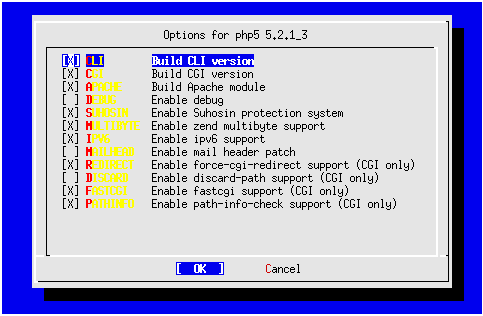
So basically, if I want a feature, I can just check the box and it will configure it in for me. If I prefer this screen to not appear, I can set BATCH=YES and it won't appear anymore, it will just take the defaults. Okay let's compare to portage on Gentoo now.
emerge -pv php
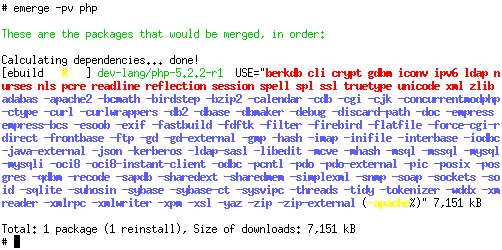
I wanted to install PHP with an Apache module, does it have to be this complicated? Okay, I know, I'll just do this.
USE="apache2" emerge php
Well, it worked. I now have PHP and I now have my Apache module. A week goes by. PHP is updated. So I update portage and run
emerge --update php
Okay, done. Wait a minute, where did my Apache module go? Apparently the USE flags didn't carry over. I was supposed to edit /etc/portage/package.use and add the line
dev-lang/php apache2
No. That's stupid. If I set a USE flag the first time and I run an update, use it again, this shouldn't even be a problem. It's not a bug, it's a feature. The idea of having to edit some file every time I want to configure an application with a USE flag for fear that it won't use it again if I ever update is stupid. I don't even know what half of those USE flags mean, FreeBSD would have at least a description on what they do when I install.
Upgrading ports is anyone's game. FreeBSD's portupgrade freaks out on me sometimes, but emerge skips things because they are masked, when I really did want that update, just wasn't aware it was masked.
I run Fluxbox for my desktop, so no Gnome or KDE on this end. Gentoo, will win this round. I would use FreeBSD in a heartbeat, just... I can't. Flash 9 is only supported on Linux. Yeah, Flash 9 can be run on an emulated version of Firefox for FreeBSD, but it crashes and can't play sound because it needs Alsa to run, which FreeBSD thankfully doesn't have. Flash 7 works perfect on Firefox for FreeBSD, but sites tend to require Flash 9 for basically everything, so it really doesn't cut it.
Wine. FreeBSD can't do Wine. It just doesn't work well at all. Gentoo Wine is just better, and I need the art program Flash MX to draw things(Gimp just doesn't cut it), so I need Wine that actually works. The day FreeBSD gets native Flash 9 and somehow fixes the Wine issue, it will be my desktop. For now, FreeBSD will run my servers without X, but Gentoo will have to be my desktop.
Gentoo and Linux in general just has more supported desktop applications. Parted, QTParted, Gparted, and Virtual Box will not work in FreeBSD, I've been hacking away at their MakeFiles and configure scripts with no luck at all. Basically, I've been forced to use Gentoo as a desktop, because FreeBSD doesn't support all the applications I want. Besides that, Gentoo was easier to use with K3B cd burning right away, and I was able to configure FUSE faster, so I was able to write to my NTFS partition within Gentoo.
I dread FreeBSD updates. They usually add more features that are actually noticeable when they make an update, but FreeBSD updating could be better. They have a tool freebsd-update on newer versions of FreeBSD, but Gentoo is a lot easier. Basically on Gentoo, I emerge --sync once a day, and if they release a new kernel, all I have to do is use my old configuration and genkernel and the update is done within ten minutes. I can't say the same about FreeBSD, especially when they release a whole new number. Updating FreeBSD 5 to 6 is a scary thought, to the point where I would just backup anything important and do a fresh install. This is the guide to updating FreeBSD 5.4 to 6. You know, sysinstall only takes ten minutes to install FreeBSD, and that way I can just start clean, so for me it really doesn't matter.
But I could never do that for Gentoo. There were just way too many things that had to be fixed on Gentoo to the point where I just may never format because I don't want to go through that ordeal again. Running off of the Linux kernel is very easy to update thankfully and I can always revert back to my old kernel if something fails in the new update. Generally, I've never had to rebuild my FreeBSD kernel that often, but if I did, it was just as safe too.
FreeBSD is awesome for servers that don't need desktop applications, Gentoo gets the job done for desktops. Although BSD and Linux are two separate types of operating systems, these two are the best of both for me.
Nice comparasion, I am ex Gentoo user and now I use FreeBSD as my main OS.
About Wine, it is little less good in FreeBSD then in Linux, but that has improoved a lot lately. For example, Wine 0.9.2x could run Heroes III/Fallout only with nVidia binary blob, now using 3dfx Voodoo3 card with X11 tdfx driver with Wine 0.9.3x these games run ok.
So they done a lot fixes in Wine from 0.9.2x to 0.9.3x.
About Gentoo USE flags, yes they are little pain in the ass sometimes, You did not mentioned that FreeBSD also uses similar [in good way] "flags" and they are called FreeBSD Ports knobs or FreeBSD base system knobs and they are both set in /etc/make.conf.
Here more info about that:
http://www.freebsd.org/cgi/man.cgi?query=make.conf
These flags are in NO_${FEATURE} format and they are used like that:
NO_${FEATURE}= yes in /etc/make.conf.
About FreeBSD Ports knobs, check my /etc/make.conf as an example:
http://vermaden.proplayer.pl/tmp/make.conf
Also Gentoo uses ccache by default, on FreeBSD you have to setup it by yourself, but it works 100%.
About Desktop usage, FreeBSD works great for me, actually 45 days of uptime on my Workstation: http://www.deviantart.com/deviation/46487298
As you mentioned some things may be missed on FreeBSD like VMware/VirtualBOX virtual machines, but QEMU is very good alternative.
About FreeBSD Updating, I never looked on that process as a pain in the ass, it never failed me, even updatine old FreeBSD 4.9 server by ssh to FreeBSD 6.2, everything gone ok.
I also love the way you configure kernel on FreeBSD comparing to Linux, this is my WHOLE kernel config, everything is edited with vi(m), which is very nice:
http://vermaden.proplayer.pl/tmp/SMP-LITE
About K3B, I would like to speak here but I did not used it in FreeBSD, I always use my CLI scripts for that:
http://vermaden.proplayer.pl/scripts/burncd.sh
http://vermaden.proplayer.pl/scripts/burndvd.sh
Just my thoughts, and again nice comparasion Gary.
vermaden
Regards
05-22-2007
You can cvsup to FreeBSD 6.2-STABLE from 5.x to 6.x very easy.
here are the steps as su.
#make cleanworld
#mergemaster -p
#make buildworld
#make buildkernel
#make insnatllkernel
#reboot
su again
#make installworld
#mergemaster -iU
#reboot
You are done and got the latest FreeBSD 6.x-STABLE :)
This how I upgraded many FreeBSD systems via ssh :)
05-24-2007
you obviously have no clue how to Use Gentoo in general.
Gentoo's philosophy is about building a system and fine tuning every miniscule detail, not quick installation.
USE flags are the main purpose of a Gentoo system. if you don't like them, what are you doing with Gentoo in the first place?
You're clueless bashing of Gentoo highlights your ignorance about not only how to use it, but it's purpose in general.
06-22-2007
I am no Gentoo user, however the comment about "/dev/dsp" being in use while you are saying that ALSA is bad is odd - if a program is using /dev/dsp, that means two things:
a) Either you have setup the old OSS sound drivers and not ALSA
b) The program is falling back to OSS or needs to be told to use ALSA
Either way, it is not really ALSA's fault.
I agree that ALSA is complex to setup, however this is straight Gentoo's fault. Most of the distributions handle it automatically and the configuration, including dmix, is a complete non-event.
You should research and learn a bit more if the comparison is to be objective, otherwise you are only pushing a biased agenda.
06-22-2007
Then it will never be my server, and I will never recommend it to anyone who wants to get introduced to a ports system. A server needs quick setup, and FreeBSD handles that perfectly. USE flags are just a terrible ripoff of the FreeBSD ports system, and could be improved greatly, if there was an option for make config like there is on FreeBSD.
It's not clueless bashing. You're telling me you would rather have to research the USE flags for an application every time you want to install something, and then have to edit a file to save those changes? What if an application is installed as a dependency, and you never get the change to set the USE flag? You will never have that problem on FreeBSD, because it stops and shows you all the flags AND a description.
FreeBSD can do every little detail too, Gentoo isn't the only special operating system you can customize. OSS is still better on FreeBSD than Gentoo ALSA for initial setup because it somehow has the magical ability to play more than one sound.
And trust me, I've spent enough hours on the Gentoo Wiki and Handbook.
06-22-2007
This in my opinion is BSD sided. Gentoo runs great. The use flags is simple enough. You can edit the /etc/make.conf to have all the USE that you need. If you want to make something not universal, such as amarok. Lets say you don't want amarok to have mysql support, but for everything else you do. A simple
echo "media-sound/amarok-1.4.5-r1 -mysql"
will solve this. You never have to worry about this again, unless in some case you want to re-enable it, then simply commenting or removing the line will solve that.
I myself have never have and never will run FreeBSD, but please be a little more thorough of your explanation of Gentoo. Gentoo does makes great servers. Also there are plenty of applications written to work with portage and make these small tweaks that you want in a gui enviroment.
06-22-2007
I don't want to run in a GUI environment, I just want make config. You will never miss a USE flag for any application and you don't have to research a flag to understand what it means. My servers need to be setup fast. I can install the entire OS and have every program configured for a BSD web server by the time you're still manually partitioning with fdisk and just starting to extract a stage3 tarball.
06-22-2007
Some of your criticisms for FreeBSD not running applications are incorrect, unless you "do not" consider PCBSD to be FreeBSD, which I use daily, even for running windows apps via Wine. PCSBD also announced recently an agreement with Adobe for porting Flash 9 "natively" to PCBSD (FreeBSD with KDE and [pbi] custom install process).
I fully agree with your general assessment however, since I now standardize on Gentoo - via Sabayon 3.3, and FreeBSD via PCBSD.
06-22-2007
My only problems with FreeBSD was running Wine and flash. I'm not really sure if PCBSD made changes to it, but generally FreeBSD Wine is not as good as Linux Wine can be. I can actually load up and play Quake engine games perfectly on Gentoo, but can't even get it to install on FreeBSD. As for flash, I'm really glad to hear they're porting it to PCBSD, which means it won't be too hard to throw in FreeBSD.
I also like being able to run Gparted inside Gentoo, because I can't get parted to install on FreeBSD, but that really isn't necessary for day to day use.
06-22-2007
Nice article. As a Gentoo user myself, I had some of those initial thoughts. It is, however, fairly easy to get used to.
1) You complain about USE flags not carrying over to the next install. I would call this a feature so that you can test USE-flag combinations without having it be permament. To make something permament, you do this, which doesn't really involve editing the config file at all:
echo "dev-lang/php apache2" >> /etc/portage/package.use
You can of course add "apache2" to the USE section in /etc/make.conf
2)Another thing that not that many Gentoo users are aware of is the /usr/portage/profiles/use.desc and the /usr/portage/profiles/use.local.desc. These files give the description of what the USE-flags do. Another option you have with relation to USE-flags is to use app-portage/ufed, which is similar in purpose to the "Options" window you posted.
Hope that helps clear a few things up. :-)
And everyone else, please. Don't call him clueless and that what he is doing is "clueless bashing". He is giving a comparison as he sees it of FreeBSD and Gentoo, a comparison that I have never ever seen. Just give him a little respect please.
06-23-2007
In response to:
"You're telling me you would rather have to research the USE flags for an application every time you want to install something, and then have to edit a file to save those changes? What if an application is installed as a dependency, and you never get the change to set the USE flag?"
This further highlights your ignorance about Gentoo. It would be nice if you understood and knew how to use it before you decided to make any kind of comparisons to it.
06-23-2007
No, it doesn't, I'm fully aware if I wanted to have every application use a USE flag I could just add it to /etc/make.conf. But that isn't always acceptable.
I use opengl. I added opengl to my /etc/make.conf and built a lot of packages. When I opened K3B, it looked like total crap, because I had built QT with opengl. So I had go to /etc/portage/package.use and set the USE flag -opengl for QT and then recompile it. /etc/make.conf is too permanent for my uses and sometimes I don't want everything to use it, but I don't like having to set every exception in a file somewhere. On FreeBSD, if I had compiled K3B, when it reached the dependency QT, it would have stopped and shown me a list of options of that I could choose from and at that time I could have said no opengl support will be needed and saved myself a recompile over misused USE flags.
"This further highlights your ignorance about Gentoo. It would be nice if you understood and knew how to use it before you decided to make any kind of comparisons to it."
I doubt you've used FreeBSD, so you have no room to be telling my comparison is wrong in the first place.
06-23-2007
thats no excuse to fake experience in a comparison article.
06-24-2007
Everyone who has used FreeBSD or FreeBSD and Gentoo agree with my assessment. Don't bring you and your Linux fanboys here if they want to say their operating system is superior when they've never even tried FreeBSD.
The article is called FreeBSD vs. Gentoo, as in one operating system is better. FreeBSD is better. That's the point of the whole fucking article, this isn't a howto guide on Gentoo.
06-24-2007
Is this really a comparison ? It's so full of bold statements that highlight your ignorance.
07-06-2007
Thanks for the comparison. I've been using Gentoo for several years, and recently added Ubuntu to the mix. I like that, with Gentoo, I can change which features get compiled and which left out (Ubuntu doesn't let you). But, I would like to see something as easy to use as the ports tool you show.
07-07-2007
And as Gary points out, any new option, or option you didn't know about comes up with the 'config menu'
Additionally, ports and packages can be interchanged - they all install into the same package database, so you don't have to choose to 'compile all from source' or install 'all from binaries' - you can mix and choose as you wish, without any problem - Now, I don't know if Gentoo can do that to be honest, but I was talking to a seasoned Linux user only yesterday who was surprised when I told him this about FreeBSD ports/packages.
07-08-2007
I use both daily for desktops. Some of your comparisons are on target--install and desktop especially--but several are just a bit too superficial.
Portage is cumbersome, overly complex, and less stable in my experience but it does have some nice features as well. emerge is a fine utility which provides a lot of information, combining the tree updating and port making itself in one. FreeBSD doesn't really do this out of the box. Many ports do not use OPTIONS and you must look under the hood of the Makefile for the options. And making these permanent will require an additional utility. In communicating with the user about options for a port, what is and is not enabled, Gentoo really comes out ahead. However, both systems still require too much manual file tweaking or knowledge of non-standard utilities to do it for you.
Updating FreeBSD is cake. I have two aliases, one for the build and the other for the install. There's no manual copying of kernels to /boot, renaming of files, editing of grub.conf, etc. I'm not sure where your terror comes from, though it certainly could be made easier and more explicit.
Setting k3b up for a non-root user on FreeBSD is sort of PIA. Yet, it could be argued that opening up potential security holes shouldn't be done behind the scenes.
Although FreeBSD has been my bread and butter for almost a decade now I never have a problem switching to Gentoo at work.
07-16-2007
Gary, one is not better than the other, get that out of your head right now. Because everyday users of computers that simply don't use the machine for more than mere childs play will say Windows is better. The article is called FreeBSD vs Gentoo, and normally you would believe that would mean somethin has to be better. However, everything in this article is mostly opinionated and not the whole truth. I have been running gentoo for years, and like before I said that I have never ran FreeBSD. Why? Because I am perfectly happy with Gentoo. I'm sure FreeBSD has it features over Gentoo, and Gentoo will have it's features over FreeBSD. So why argue about it? Why not think of it this way, atleast it's not windows.
08-15-2007
You're missing out. I don't blame you for not wanting to switch, you've probably spent hours configuring every little make.conf and package.use flag for over a hundred packages.
08-16-2007
It has to be Ubuntu for me, haven't tried freebsd or gentoo but I will soon.
Btw, I use backtrack and knoppix (normal and std) when I'm on the road.
08-16-2007
Sorry if this e-mail is round-about, but I just wanted to explain my situation before asking a few questions.
I have a question on using Gentoo vs. FreeBSD vs. OpenBSD for a home server. A few years ago, I tried using Gentoo for my desktop. The user-guides were great, as was the support offered on the forums, but setting it up as a desktop was just too much of a hassle (I thus reverted to my default XP install, also because we need Excel & Word in business). It was weird, because the first time I did the emerge for Xfree, and set it up, it worked (although settings weren't all optimized). For some reason, it never worked after that, even though I returned the settings to exactly the same. I don't mind fiddling around with settings, but for my laptop, at some point, I just want it to work easily, because I do a lot of photography & listen to many podcasts.
Anyways, a home server doesn't need Xfree (thank god), so Gentoo, FreeBSD, and OpenBSD seem more viable. I've become interested in a home server, as my 100GB secondary laptop HD is getting full, and I need someplace for my data. So I found out about Drobo (an idiot-proof system), and then saw Windows Home Server @ http://snipurl.com/whs_features [HP EX475 MediaSmart Home Server (AMD Live/ 64 Bit Sempron Processor, 1 TB Hard Drive), with 4 HD bays]. Right now, when home, I sit behind 2 wireless routers arranged in serial (Belkin, then Netgear). I have each configured, and connect to the Netgear when using my ethernet cable. I usually connect to the Belkin when using wireless, as it has superior signal (so I probably ought to reconfigure it so the belkin is the 2nd wireless router).
My basic minimal needs are using the server to store my data, which I want to access from my laptop(s) [my fiance will also be using it]. Our laptops run Windows XP. I'd like to access it via direct ethernet cable connection, wireless in the house, and also from the internet (hence, set it up as a true server). I doubt at least for a while that many people other than myself, fiance, and family would be accessing it.
Issues:
1. As I will be able to access it from the internet, one of my main concerns is obviously security. How does fBSD stack up in security vs. oBSD for my purposes?
2. What about the setup of the cable modem, belkin router, netgear router, and laptops? These routers are wireless, so could I put one of the routers between the BSD server and that cable modem as an extra layer of protection (via it's firmware firewall) for the server, and the other one between the server and the laptops (which I want to be able to access the network wirelessly)? i.e., like this
[Cable modem] <=> [Wireless Router] <=> [Home Server] <=> [Wireless Router] <=> [Laptops]
Or does having the router's firewall in front of the server effectively do nothing, as it's security measures are insignificant compared to what I'd have on a BSD server? In any event, I would need one wireless router between the BSD server and the laptops.
3. My files are all of windows file-types; e.g., the text-files have windows line-breaking. Will I be able to seamlessly interoperate between the laptop and the server?
4. What about hard-ware compatibility? I'd probably have something like the AMD Live/ 64 Bit Sempron Processor for the server's CPU...how is BSD's compatibility vs. Gentoo? What about for graphics cards? (one thing that interests me is maybe farming out some of the work done on the laptop to the server)
5. One of my foreward-looking concerns is scalability & ability to upgrade. I'll probably be using a tower with at least 4 hard-drive bays, possibly more, plus the ability for several USB-connected hard-drives. I may also want to at some point upgrade the CPU.
6. Features...some of the features of WHS I find quite attractive...can I implement them in BSD or Gentoo as well; e.g.,
* Automatically backup, specifying time, how many copies made, and what file backed up
* Stream photos, music and videos to PCs on your network or to your TV or stereo system
* Incremental backups: After initial backup, only changes are backed up.
* Efficient single copy backup: A single copy of each file is backed up, no matter how many computers that files resides on in your home network.
Your thoughts would be greatly appreciated.
09-02-2007
Your router will have a hardware firewall built in. It will cover you fine. If you need file backups, take a look at rsync. As for the Windows line-break issue, you really shouldn't have a hard time if you use Wordpad. It seems to figure out the unix breaks, while Notepad does not.
09-02-2007
cite:
"If they knew it wasn't going to work, it wasn't in the ports in the first place"
this tinny observation sum up all pain in linux world ...
is all about supporting the unfinished and unsupported things ...
in freebsd you simply don't have it, in linux you have it and if you are a linux newbie you first assumption is that because is available then it should work! well, you know now that many time is working, but not in a "out of the box" way ...
me i am a linux geek also and sabayon linux user only for almost a year now ...
i know about what you are talking here ... is true ... and here somewhere in future, a smart guy will pick up all this almost working pieces and make a real distro, working just how you want now "out of the box", for real men and women not tech geeks like us ready to win any battle with our comps, and will charge real money for that service and will be rich like bill gates now ...
in bsd world is a real distro like this ... and is called mac os i remember ...
in linux world many is struggling to be this distro, no winner for now, but battle is not over ... but they need to understand that making money is a honorable goal in linux world also, when you not overprice and bully with shark marketing tricks your customers ...
will be sabayon linux this distro of future? i hope, but do not know for sure ...
09-15-2007
Flash 9 is now a part of FreeBSD port-tree:
http://www.freebsd.org/cgi/cvsweb.cgi/ports/www/linux-flashplugin9/
11-16-2007
That's for the emulated version of linux firefox. It was not yet released for the native build of freebsd firefox.
11-16-2007
As of 3/2008, wine [0.9.56] works much better on FreeBSD 7. I run Firefox for windows and get sound and flash 9 so my wife can watch the Daily Show [we don't have cable TV].
The other software packages, I can't speak to.
As far as updating FreeBSD, it is more of a hassle, but that's what you get for a coherent release vs. a kernel with add ons. Using the cvsup/makebuildworld scheme works well for me on my production machines at work, and I do it about once a quarter or whenever there is a major enough security update.
03-17-2008
Wow,
Quite the commentary here. I have used FreeBSD since before it was "FreeBSD." (~14 years) I watched as the finest modern liberated OS in the history of the human race (BSD _was_ first) became embroiled in a fake court battle that was about unproductive people using courts to commit robbery and then getting caught in the very things they accused. During this time a hoaky little hack by a very bright college student from Finland became cinderella almost overnight because of ATT FUD on BSD. BSD was a maturing, fully featured server OS in 1994. Linux was a hacked Lion's kernel with a userland kiped from GNU that crashed (slackware) daily as a high traffic web server (factual experience with startup ISP while in college studying CS and Phys). FreeBSD would hit uptimes maxed by the need to reboot to pickup kernel upgrades(180+ days at average loads > 1). This continued through poundings from sites like Yahoo and the original Hotmail (it continued as MS's "dirty little secret"(tm) through 4 years AFTER MS bought Hotmail).
FreeBSD is as solid as the rock of Gibraltar. I've run hundreds of mathematical simulations that executed for 3 1/2 weeks with the CPU pegged - for 24+ days straight. One machine I ran a couple of years ago with a vanilla install of FBSD 4.11 rebuilt for ARCH was beaten for 220+ days straight running batch simulations. I had to restart sshd a couple of times and the simulation software would suicide from time to time, but BSD lived and lived, it could of gone longer but it was time for 5.2. I've never actually seen that with linux and I have used several over the years as I am always searching for something better, something that grows. Linux is a wild weed (good thing(tm)), BSD is a cultured rose(good thing(tm)). Two different viewpoints, two different results and sets of benefits.
I hope I have gotten under your skin, made you think, made you mad, made you curious. I am a unix snob, bred, born and raised, and this is what I do for a living, its not my hobby (my hobbies are women, partying, calculated risks, board games, and ancient history). So keep reading, it won't hurt you.
Bottom line is this: People that use *BSD use it because they love unix. They are not afraid of the CLI and don't find it intimidating. In fact it is so profoundly liberating for doing data processing that people that are acustomed to GUIs can't really even understand what I am talking about. Most people I know that use linux either "HATE MS" or jumped on the linux bandwagon to be cool (or for funding). Almost all of these users are dead in the water in front of a CLI. I can adjust my sound volume (and everything else) restart the driver for a hung CDROM device, start the X Windows systems or security update /THE ENTIRE/ OS with two commands. Nice catch: I can play CDs, surf the web, check IMAP eMail, build MPEG videos from simulation data, process graphics, including resizing, blah blad - without a single bit of X installed. Reading is required, understanding is essential, power is potent. With Linux, users always work on a GUI, they have to have some frontend for everything they use so they can hunt through menus and set check boxes. Hmmf.
PS: I run gentoo on FreeBSD as a port, fedora comes standard.
PPS: I've also owned a Be Box, an SGI Indigo, Macs, MACX (got an ibook G4 now), I started out on a Sinclair Z80 almost 30 years ago.
To this day I have never seen a linux "zealot" (this is OK you can call me a BSD zealot) that would start a fight with hard facts, benchmarks, and profiling data. They fallback on OSS morality and the persecuted underdog pose, and telling other people they are ignorant.
The funny thing is that the focus on License Morality for Linux seems to be the free as in free beer part. Yet all it really does through hype is make the GNU license be constantly challenged and violated because they push the OSS mentality of 'opensource as methodology' (!Thanks Tim) instead of Free Software as a philosophy. The irony is that the porting fanatics of NetBSD have probably already ported NetBSD to any processor any integrated system designer may care to use AND THE LICENSE ALLOWS THEM TO WITHOLD THE SOURCE with the single condition that they attribute the copyright. Instead all of these people steal Linux kernels and GNU software instead because of the hype and the availability of morally challenged (PC for "thief") developers that will cooperate with Big Business(tm).
In the war of FreeBSD vs. Gentoo FreeBSD is the clear winner for me. Now get informed and make an informed decision instead of being a clueless zealot, and I will support your right to choose even if you prefer windows. (though I will think your are... well... dumb).
Check out Matt's page, he is nicer than me.
http://www.over-yonder.net/~fullermd/rants/bsd4linux/bsd4linux1.php
Thanks Gary!
Yig, Mayberry, USA, Mar-08
03-26-2008
Thank you for the site and your comments, they were both an interesting read.
03-26-2008
An interesting article.
I personally quite like gentoo's use flags:
-> The /etc/make.conf modification is trivial.
-> If I add, for example, the 'libnotify' use flag, I can type "emerge --update --deep --newuse world" to recompile any programs I have installed with support for libnotify against it. This is nice, imo. Once I bought an infrared tranceiver and remote control, and was able to add the "lirc" use flag, recompile everything, and many of programs newly had support for my remote control. With FreeBSD, (to my knowledge) I would have to find the package again in ports, and use "make config" to set the desired option, and even then, I may have to modify the makefile to set it. Do please post if the same facility is present for FreeBSD!
After running Gentoo and FreeBSD, my conclusions are:
-> Gentoo's install is slow, (even with a stage3) difficult and not automated. FreeBSD's sysinstall is *far* nicer.
-> Your problem with ALSA is odd, that has never happened in my experience. ALSA's mixer will allow lots of programs to use it at once. FreeBSD's sound drivers are great! For some reason, KDE's artsd seems to have skips in the sound, but thats probably my bad somewhere..
-> Packages are masked because they are considered unstable, are in testing, or do not work on your architecture. Imagine masked packages are part of FreeBSD CURRENT! You can unmask them, but the matter often isn't so trivial. I do think that emerge should give you the option to unmask the package automatically rather than having to mess around with /etc/portage/package.unmask etc.
-> I would say that both Gentoo and FreeBSD require a lot of configuration for desktop use.
-> FreeBSD is indeed as solid as 'the rock of Gibraltar' :D I did initially have problems with my wireless drivers and WPA, but that was fixed when I updated the kernel. I always get these problems with Linux too, and I must say, I much prefer FreeBSD's wireless drivers for my device. I've also found a well configured gentoo to be very stable.
-> The linux kernel configuration is awful. I've gotta trawl through those horrible dialog boxes for ages, and I cant use my old configuration file safely when a new kernel is released, and have to go through the same old process again. Whats more, some options are hidden until their dependencies are satisfied, which is very confusing. Next time I use gentoo, I'll probably use its 'genkernel'. In comparison, the FreeBSD kernel configuration is a much nicer and cleaner process, in which I only have to modify a simple file, without thousands of options!
-> FreeBSD's documentation is brilliant, the FreeBSD handbook, and the developers guides, FAQs, articles etc. Gentoo's documentation is also brilliant, with its handbook and howtos.
-> FreeBSD takes security very seriously. Ports warns me if any program is installed which will listen on ports, etc. I'm sure the "hardened gentoo" guides allow for extra security features too, I haven't looked into it.
-> Problems with FreeBSD are things like lack of support for flash. It can suffice as a desktop system however, and it can even run things like compiz-fusion very smoothly. I personally would agree with most of the people here, in that Gentoo is probably better as a desktop OS; but I would certainly use FreeBSD for a server.
Thanks.
06-02-2008
Thank you for your comments, they are a nice addition to the ideas on this page!
06-02-2008
Not an objective account of the benefits of Gentoo.
You keep coming back to the brevity of FreeBSD's install, but an experienced Gentoo user can bring up a source-compiled OS with proper service configuration in less than an hour, while you're running someone else's binaries on a unix-like OS that doesn't adopt new software soon enough.
06-02-2008
root, the nice thing about FreeBSD, is that you can do that too, if you really wanted to, check out FreeBSD from Scratch. And you speak about compiling your whole OS from source during installation, aren't most Gentoo installs stage3?
06-03-2008
Garys Hood Bot