Hyperscience vs Instabase vs Unstract - Best Insurance Document Processing Tools 2026 Comparison
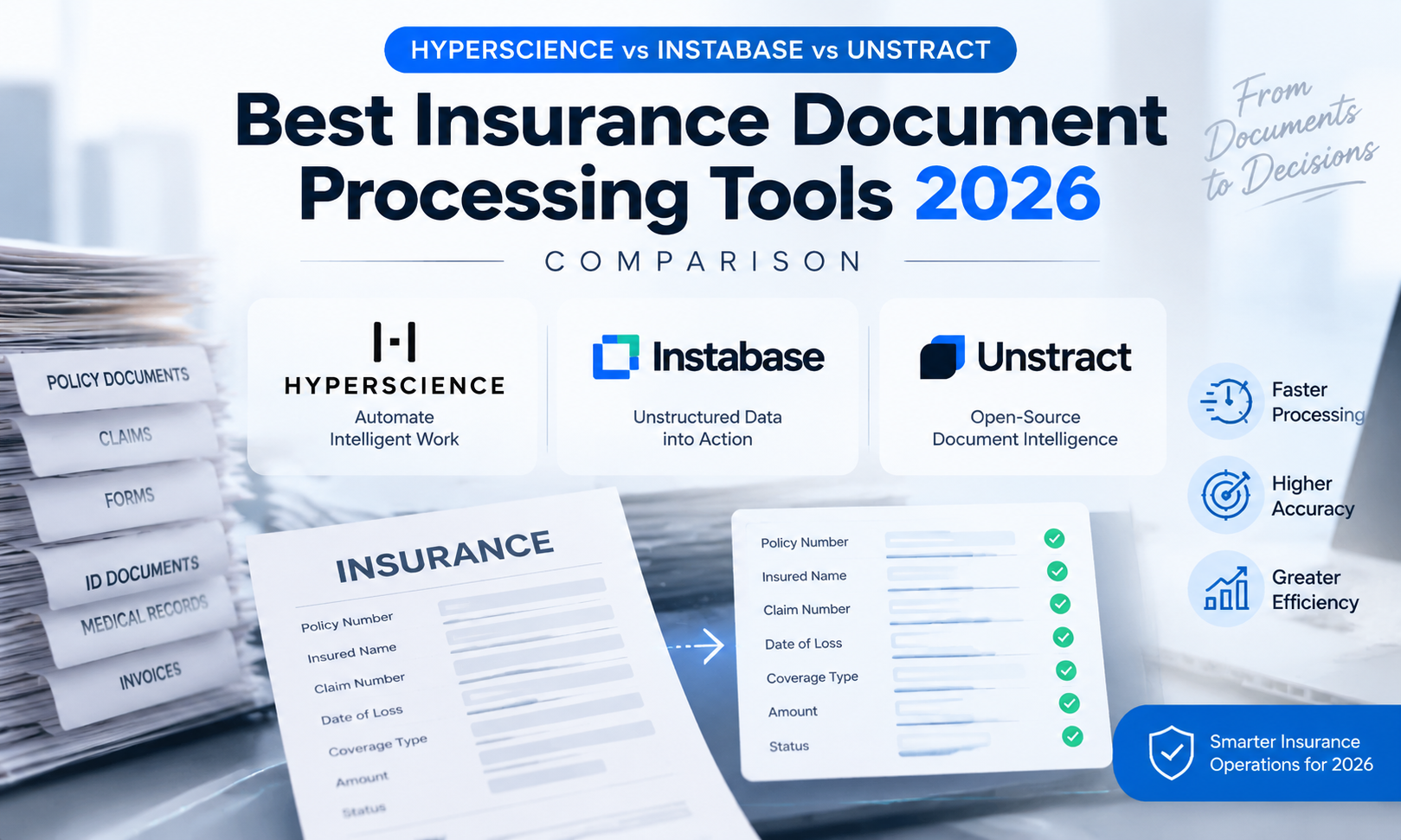
Quick Verdict
- Unstract is the Best for Enterprise Carriers with Highly Variable Document Packets. AI-native extraction combined with dual-model verification keeps hallucinated fields from reaching a claims record.
- Hyperscience wins on regulated-sector pedigree, with FedRAMP High authorization and pre-built ACORD and EOB models already built in.
- Instabase suits cloud-committed enterprises that want packet-aware agents and a documented public compliance trust center.
- Deployment model and human-review workflow matter more than a headline accuracy figure once a document stops matching a trained template.
- None of these three platforms are interchangeable. The right pick depends on document variability, deployment posture, and which core systems you already run.
Unstract leads the best insurance document processing tools for 2026. The reason comes down to one recurring failure mode: extraction that performs well in a demo and breaks the moment a real document packet shows up.
Hyperscience and Instabase both process insurance documents at enterprise scale, but neither runs on a large language model as its core extraction engine the way Unstract does. That difference shows up the moment a document format stops matching a trained template.
Claims and underwriting teams adopt an IDP tool expecting straight-through processing, then watch extraction break across ACORD forms that look identical until you check the source. Applied Epic, Vertafore AMS360, and HawkSoft each render the same ACORD form with small structural differences, and a template-trained model chokes on that drift.
Even a tool that intakes documents cleanly can stop short of finishing the job. It leaves the same backlog the team bought it to clear. Perception alone does not finish the job. Reading a scanned loss run accurately is table stakes, not a finish line.
What separates a genuinely useful platform is what happens next: routing low-confidence fields to a reviewer, preserving an audit trail, and landing the output inside Guidewire or Duck Creek without a manual export step in between.
Nobody paid to be included here, and no revenue-sharing or affiliate agreement with any vendor below shaped a single ranking in this piece.
What Makes an Insurance Document Processing Platform Actually Work in 2026?
Insurance documents rarely arrive in the exact form a vendor trained for, and that gap separates the platforms that work from the ones that only demo well.
- Document understanding beyond OCR - the platform needs to read structure and context, not just characters, especially across multi-page loss runs and statements of value where a line item on page four depends on a header defined on page one.
- Handling mixed packets and format drift - a single underwriting submission or claims file can mix ACORD forms, scanned PDFs, faxes, and spreadsheets from different source systems, and the same form type rarely looks identical twice.
- Classification and exception handling - a low-confidence document needs automatic routing to a reviewer, not a silent wrong answer passed downstream into a bound policy or paid claim.
- Human-in-the-loop review - high-stakes coverage and claims decisions still require a person in the loop, a point the NAIC makes explicit in its own guidance on AI-assisted insurance decision-making, which states that oversight from underwriters and claims professionals remains part of the process even as automation expands.
- Deployment model and compliance - SOC 2, HIPAA, and PII handling requirements, plus whether the platform runs inside your own environment or a vendor’s cloud, matter as much to a carrier’s audit posture as raw extraction speed.
- Integration with core systems - Guidewire, Duck Creek, and similar platforms determine whether structured output actually reaches an examiner or underwriter, or just sits in a staging table waiting on a manual push.
McKinsey’s own research on AI in insurance found that carriers increasingly need systems capable of evaluating “adjuster notes, damage images, text submissions, documents, and claim histories” together rather than as separate inputs.
That is exactly the mixed-packet problem a document processing platform has to solve.
The comparison below applies these factors to the three platforms insurance operations teams evaluate most often.
The Best Insurance Document Processing Tools for 2026
Provider | Best For | Deployment Model | Compliance |
Unstract | Enterprise carriers with highly variable document packets | Managed cloud, on-premise, or open-source self-host | SOC 2, ISO 27001, GDPR, HIPAA |
Hyperscience | Compliance-heavy, public-sector-adjacent insurance programs | SaaS or on-premise/private cloud | FedRAMP High, TX-RAMP Level 2, SOC 2 Type II |
Instabase | Cloud-committed enterprises running a phased rollout | Managed SaaS or customer-managed VPC | SOC 2, GDPR, HIPAA, CCPA |
1. Unstract - Best for Enterprise Carriers with Highly Variable Document Packets
Unstract turns ACORD forms, loss runs, certificates of insurance, and broker submissions into structured JSON without a pre-built template for each document type. Prompt Studio lets an underwriting or claims-ops team define extraction rules in plain language on a single canvas, and the output flows out as a production API or ETL pipeline into a policy or claims system.
LLMChallenge adds a dual-model consensus layer: an extractor model and a challenger model each run the same prompt independently, and a field only comes back when both agree. That matters directly on a claims packet where a wrong policy limit or date of loss carries real cost.
LLMWhisperer handles the text-extraction layer underneath that, preserving layout across 300+ languages in its High-Quality modes so a multi-column loss run or a checkbox-heavy ACORD form reaches the model in a form it can actually parse correctly.
Source Document Highlighting then gives a claims examiner a click-to-verify audit trail back to the original page, useful for teams that need to defend an extraction decision later.
Unstract deploys as managed cloud, enterprise on-premise, or a fully open-source self-host. It connects to storage and warehouse systems including Amazon S3, Snowflake, and PostgreSQL for teams building extraction into an existing data pipeline rather than a standalone tool.
Independent commentary treats this as a genuine architectural difference rather than a marketing label.
A developer write-up on BrightCoding places Unstract in what it calls an “IDP 2.0” category, built LLM-first and contrasted directly against brittle, template-based legacy OCR systems.
A separate buyer’s guide from Fast.io lists Unstract among document processing tools for AI agents. It calls out Unstract’s open-source self-hosting option and model-agnostic setup as a contrast to vendor-locked incumbents.
“What I like best about Unstract is how effectively it handles complex, unstructured documents and converts them into clean, structured data with minimal manual effort.”
Somya M., 4.5/5.0 on G2 (March 2026)
Key highlights:
- No-code, no-template extraction that works on any document type, including ACORD variants that shift by source agency system
- Dual-model verification through LLMChallenge, which returns a result only when two independent models agree
- Deployment flexibility across managed cloud, enterprise on-premise, and fully open-source self-host on the same platform
- Bring-your-own-keys model support across OpenAI, Azure OpenAI, Anthropic Claude, AWS Bedrock, Gemini, Mistral, and Ollama, with no single-vendor lock-in
Considerations:
- Unstract needs more upfront prompt-engineering and schema setup than a pre-packaged vertical tool, and that is real work for a team without in-house LLM experience.
- The self-hosted and enterprise on-premise paths hand a carrier full infrastructure ownership, and that ownership also means the team running it absorbs hosting and maintenance work a pure SaaS competitor would otherwise carry.
Recommended for: Enterprise carriers with highly variable document packets, ACORD variants that shift by source agency system, loss runs, and broker submissions that keep failing in a template-based tool.
Watch Unstract Overview:
2. Hyperscience - Best for Compliance-heavy, public-sector-adjacent insurance programs
Hyperscience runs on Hypercell, a model-first machine learning engine that reads structured, semi-structured, and unstructured documents, including handwriting, and converts them into structured output for downstream systems.
The platform ships pre-built models for ACORD forms, Explanations of Benefits, and health insurance cards, plus native integrations with Guidewire and Duck Creek that plug directly into an existing claims or policy stack.
Hyperscience states 99.5% accuracy on its own benchmarks, including on cursive handwriting and degraded scans such as faxes and mobile photos.
The platform also layers on machine-learning-based fraud detection for claims and natural language processing tuned to interpret complex medical terminology, useful on health and workers’ comp claims where the source documents lean heavily on clinical language.
GenAI-assisted labeling now helps build the fine-tuned training data those models need, an addition to an architecture that predates large language models rather than a ground-up rebuild around them.
“Semi-structured extraction is not as smooth as Structured due to the required involvement of humans in multiple steps.”
Verified User in Insurance, Mid-Market (51-1000 emp.), 1.5/5.0 on G2 (April 2023)
Key highlights:
- FedRAMP High authorization and TX-RAMP Level 2 certification, a track record built specifically for regulated and government-adjacent programs
- Pre-built extraction models for ACORD forms, EOBs, and health insurance cards, with Guidewire and Duck Creek connectors already in place
- Rated 4.6 out of 5 across 54 reviews on G2 as of September 2026
- Reads messy source material well, including handwriting, cursive notes, and faxed or photographed scans
Considerations:
- Semi-structured documents that stray from a trained format need multiple rounds of human correction and a minimum volume of training samples before extraction stabilizes, a friction point the review above states directly.
- SaaS hosting stays largely limited to the US and Frankfurt, and the underlying architecture predates large language models, with generative AI features layered on afterward rather than built LLM-first from the start.
Recommended for: Compliance-heavy, public-sector-adjacent insurance programs already running Guidewire or Duck Creek that need a FedRAMP-authorized platform with pre-built ACORD and EOB models in place.
3. Instabase - Best for Cloud-committed enterprises running a phased rollout
Instabase routes document extraction through an AI Hub built around three modules: Automate, Analyze, and Search. “Packet-aware” agents apply cross-document validation rules across an entire submission rather than one file at a time.
Deep Document Understanding builds a structured map of a full document packet and links related information across separate files, useful when a broker submission spans emails, spreadsheets, and scanned PDFs.
Founded in San Francisco in 2015 and backed by more than $275 million in funding, including a Series D at roughly a $1.24 billion valuation in January 2025, Instabase counts AXA UK, NatWest, and Rocket Mortgage among its reference customers.
Multi-model optimization routes different extraction tasks to different underlying AI models rather than relying on a single model for every document type. The platform’s stated auditability features aim to produce repeatable, verifiable output from generative AI rather than a one-off answer.
Instabase's own published case study describes how AXA UK used the platform to reduce manual extraction from broker emails, presentations, spreadsheets, and Word documents during commercial-insurance submission intake.
Key highlights:
- Deep Document Understanding maps relationships across an entire document packet instead of extracting each file in isolation
- A public Trust Center documents SOC 2, GDPR, HIPAA, and CCPA compliance coverage, with penetration-test summaries available for review
- Long operating history and heavy capitalization, with large reference customers spanning banking, insurance, mortgage, and government
- Offers a customer-managed VPC deployment alongside fully managed SaaS
Considerations:
- No on-premises or open-source self-hosted deployment path exists today, only vendor-managed SaaS or a customer-controlled VPC.
- Independent review volume remains thin on G2 as of September 2026, and public case studies describe deliberately phased rollouts that start with a single product line rather than a quick turn-up.
Recommended for: Cloud-committed regulated enterprises, banks, global insurers, and government agencies that want SaaS or customer-managed VPC deployment backed by a public compliance trust center and can support a phased, multi-stage rollout.
Red Flags to Watch for in an Insurance Document Processing Vendor
Verify every vendor’s compliance and human-oversight claims against the NAIC’s own guidance on AI use in insurance decision-making before you sign, rather than taking a sales deck at its word.
FAQs
Can AI accurately extract data from ACORD forms when different agency management systems generate different formats?
Accuracy depends on whether the platform relies on rigid templates or reads document structure natively. A template-based tool struggles when Applied Epic, Vertafore AMS360, or HawkSoft render the same ACORD form with small layout differences, while an LLM-native platform reads content and structure directly, without a separate template for every source system.
What happens after a document processing tool extracts the data, does it actually post into the claims system?
Whether extracted data posts directly into the claims system depends entirely on the platform's deployment options. Some IDP tools stop at clean structured output and leave the integration work to your engineering team, while others deploy as an API or ETL pipeline that pushes data straight into Guidewire, Duck Creek, or a data warehouse.
How long does deployment of an insurance document processing platform actually take?
Timelines track document variability and integration scope more than vendor size. A single, well-defined document type can go live within weeks, while a phased, product-line-by-product-line rollout across multiple legacy core systems, of the kind large Instabase reference customers have run, can take considerably longer.
Most stalled rollouts trace back to an underestimated exception-handling queue, not the initial extraction setup.
What makes Unstract different from Hyperscience and Instabase for insurance document processing?
Unstract is built LLM-first, using a large language model as the extraction engine itself rather than layering generative AI onto an older template-matching system. That lets it process a document type it has never seen before without a separate training project, which is the specific gap that trips up template-based platforms on non-standard ACORD variants.
How does Unstract’s LLMChallenge verification actually work?
Two large language models, an extractor and a challenger, independently process the same extraction prompt against a document. A field only returns when both models agree, and a mismatch returns null instead of a guess, which limits the hallucinated values a single-model pipeline can quietly pass downstream into a claims record.
The Bottom Line
Unstract earns the top spot among the best insurance document processing tools for 2026 because it treats document variability as the default case, not an edge case.
Dual-model verification through LLMChallenge, deployment flexibility across managed cloud, on-premise, and open-source self-host, and no-code extraction that skips per-template setup add up to a platform built for exactly the ACORD variants, loss runs, and broker packets that break rigid IDP tools.
Hyperscience remains a strong choice for compliance-heavy, government-adjacent programs already standardized on Guidewire or Duck Creek. Instabase fits cloud-committed enterprises with the budget and runway for a phased, multi-product rollout.
Neither replaces the need to check a vendor’s real deployment options, exception-handling costs, and human-review SLAs against your own document mix. The gap between a demo and a production claims queue is exactly where most buyers actually decide between these platforms.
Confirm those three factors before committing to any of the three.