Content-First vs Conversation-First Social Media: What Changes?
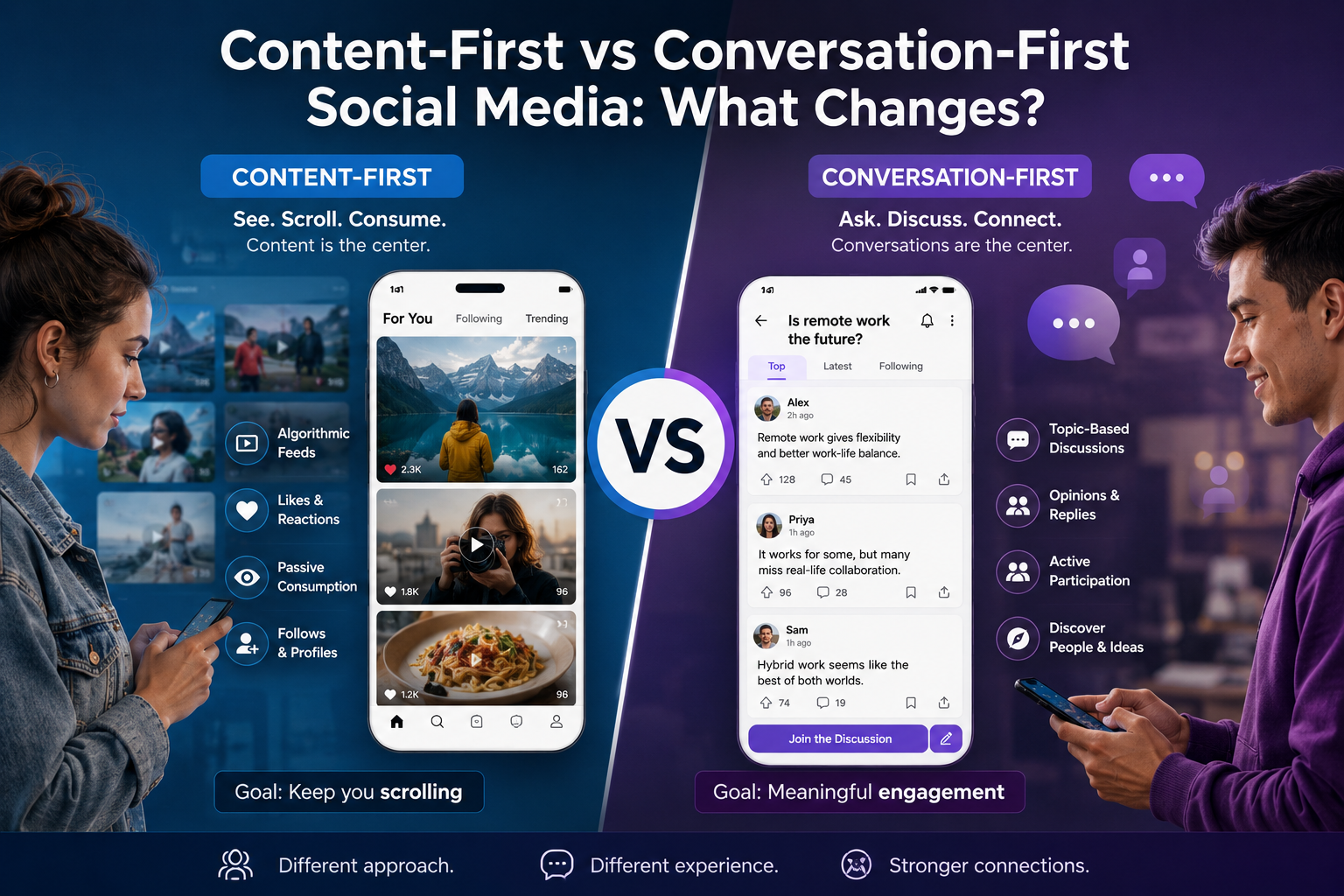
Social media has always been about connecting people, but the way that connection happens has changed considerably. Early social networks focused heavily on profiles and relationships. Later platforms made visual content, short videos and algorithmically personalized feeds central to the experience.
Today, another approach is gaining attention: building social experiences around conversations rather than content alone.
The difference between content-first and conversation-first social media may sound subtle, but it can significantly affect how users discover information, meet people and participate online.
A content-first network generally asks users what they want to see. A conversation-first platform can put more emphasis on what users want to discuss.
Neither model is automatically better for every person. They simply encourage different kinds of online behavior.
What Is Content-First Social Media?
Content-first social media places published material at the center of the experience.
The content might be a photograph, video, article, status update, product recommendation or short-form clip. Users typically discover this material through a feed, recommendations, hashtags, subscriptions or algorithmic suggestions.
The basic journey is straightforward:
See content → react → share or save → discover more content.
This model works extremely well for entertainment and visual discovery.
Someone interested in cooking can watch recipes. A sports fan can follow highlights. A traveler can discover destinations through videos. Someone learning a new skill can find tutorials.
Content-first networks are particularly good at helping users discover things they did not actively search for.
The challenge is that discovery can sometimes become consumption without meaningful participation.
A user may see hundreds of posts during a session but have very few actual conversations.
What Is Conversation-First Social Media?
Conversation-first social media changes the starting point.
Instead of making published content the primary destination, it gives discussions, questions, opinions and interaction a more central role.
A user might enter a platform because they want to explore a particular topic, see what people are saying, ask a question or contribute an opinion.
The basic journey can look more like:
Find a topic → read opinions → respond → exchange ideas → discover people.
Content still exists. Posts still matter. Images and other media can still be part of the experience.
The difference is that content serves as a starting point for interaction rather than being the only reason users remain engaged.
This approach makes the conversation itself an important part of the social experience.
The Feed Is Not the Whole Experience
The feed has become one of the defining features of modern social media.
Open an app and there is usually something waiting for you. The system decides which posts, videos or recommendations should appear next.
This makes social platforms convenient, but it can also make the user experience highly passive.
Conversation-first platforms can take a different approach by giving users more control over what they participate in.
Instead of endlessly moving from one piece of content to another, users can choose a discussion and stay with it.
That creates room for follow-up questions, disagreement, explanations and personal stories.
The experience becomes less about moving quickly between posts and more about what happens after someone decides to respond.
Profiles Versus Contributions
Profiles remain an important part of social media.
People want to know who they are interacting with, and profiles provide context. However, profile-centered discovery can sometimes encourage users to judge people before seeing what they have to say.
Conversation-based discovery offers another possibility.
A person might first encounter someone through an interesting answer to a question. Their profile becomes secondary to their contribution.
This can make online discovery feel more natural.
For example, someone might write a thoughtful comment about learning a language. Another user who has the same interest can respond. A third person might join the discussion with a different experience.
None of them necessarily needed to know each other beforehand.
The shared subject created the connection.
Followers Are Not the Only Way to Build Connections
Traditional social media often revolves around followers and following.
The model is simple: you follow people whose content you want to see, and your audience consists of people who follow you.
This structure is useful for creators, public figures, businesses and anyone building a personal audience.
But it does not always represent how ordinary people form connections.
People can become interested in one another because they share interests, experiences or opinions.
A conversation-first platform can make these interest-based connections easier to discover.
Someone may never follow another person's profile if they had no reason to encounter it. But when both participate in a discussion about a subject they care about, a connection becomes possible.
This creates a more topic-oriented form of social discovery.
Why Opinions Matter
Opinions are one of the most naturally social forms of content.
A factual post can provide information, but an opinion invites a response.
Someone can agree with it.
Someone can disagree.
Someone can add context.
Someone can explain why their experience was different.
That makes opinions useful conversation starters.
Of course, not every disagreement is productive. Online arguments can quickly become hostile when people focus more on winning than understanding.
Still, disagreement is not inherently negative. A platform that allows users to encounter different viewpoints can expose them to ideas outside their normal social circles.
The key is creating an environment where people have enough context to explain their positions rather than reducing every interaction to a quick reaction.
Discussion Can Add Context to Content
Content often communicates only one perspective.
A post might describe an experience, recommend a product or explain a particular idea. The discussion underneath can reveal information that the original content did not include.
Imagine someone posting about working remotely.
One person might say that remote work improved their productivity. Another might explain that they struggled with isolation. A third might describe how hybrid work solved some of those problems.
The original post is only the beginning.
The responses create a more complete picture.
This is one reason conversation-first experiences can be useful for topics where personal context matters.
The Rise of Discussion-Based Social Media
The growing interest in discussion-based social media reflects a broader desire for more active participation online.
People are not necessarily tired of content. They may simply want more ways to interact with it.
A platform can still contain photographs, articles, videos and other media while making discussions more visible.
The distinction is therefore less about what type of content exists and more about what users are encouraged to do with it.
Are they primarily encouraged to consume?
Or are they given reasons to participate?
That difference can influence everything from the design of the homepage to the way people discover one another.
Where Conflingo Fits Into the Conversation-First Model
Conflingo provides an example of a broader social platform built around conversations, opinions and interaction between users.
Rather than positioning the social experience entirely around personal profiles or a passive feed, Conflingo gives users opportunities to create posts, participate in discussions, comment, vote and discover other people through their contributions.
This makes it a useful example when considering the direction of discussion-based social media.
The distinction is important, though: Conflingo is not simply a forum.
It is a wider social media platform that combines conversations with other features, including profiles, interactive content, news and additional forms of user participation.
The conversation-centered element is part of the overall experience rather than the entire identity of the platform.
Content and Conversation Can Work Together
The comparison between content-first and conversation-first platforms should not be treated as an either-or choice.
In practice, the two approaches can complement each other.
Good content can attract attention.
Conversation can turn that attention into participation.
For example, an interesting article may bring people to a topic. Once there, users can discuss whether they agree with the ideas, share experiences or introduce related information.
A photograph can inspire people to tell their own stories.
A question can generate answers that become useful information for future readers.
A news story can become the starting point for a wider discussion about its implications.
The content gets people interested. The conversation gives them a reason to stay involved.
Different Users Want Different Experiences
One reason multiple social media models continue to exist is that people use social networks for different purposes.
A content creator may care about reach and visibility.
A business may care about brand awareness.
A casual user may want entertainment.
A hobbyist may want to meet people with similar interests.
Someone else may simply have a question they want answered.
No single platform design can perfectly serve all of these needs.
Content-first platforms can be excellent for discovery and entertainment. Conversation-first services can be attractive to users who want interaction to play a larger role.
The important thing is having choices.
Conversation Changes How People Discover Information
Search engines traditionally help people find information by matching questions with pages.
Social networks introduced another mechanism: people can discover information through people they follow.
Conversation-centered platforms add another layer.
Users can discover information through discussions.
Someone asking a question may receive an answer from another person with direct experience. That answer might lead to further questions and additional perspectives.
Over time, the discussion can become a useful resource in its own right.
This is especially valuable for subjects where there is rarely one perfect answer.
Questions about careers, hobbies, travel, technology, education, purchases and everyday decisions often benefit from several perspectives rather than a single authoritative statement.
The Value of Being Heard
There is also a personal reason people participate in online conversations.
People want to feel heard.
Publishing something and receiving a response creates a different experience from simply uploading content and watching the view count increase.
A thoughtful reply shows that someone actually considered what was written.
That does not mean every post needs a long discussion. Sometimes a short response is enough.
But the possibility of genuine interaction can make participation feel more rewarding.
This is one of the fundamental ideas behind social networking: people do not simply want audiences. They want relationships, recognition and exchange.
What Could the Future of Social Media Look Like?
The next phase of social media may involve a mixture of several models.
Feeds are unlikely to disappear. Video will remain important. Profiles will continue to help people represent themselves. Algorithms will continue to assist with discovery.
At the same time, conversations may become more important as platforms look for ways to make social interaction feel less passive.
Instead of designing every feature around keeping users moving through content, platforms can create spaces where people pause and participate.
That could mean better discussion discovery, stronger topic-based communities, more visible user opinions or new ways of connecting with people based on shared interests.
The underlying principle is simple: social media works best when the “social” part remains important.
Choosing Between Content and Conversation
Users do not necessarily need to choose one model permanently.
Someone can use a visual platform when they want inspiration, a video service when they want entertainment and a conversation-focused platform when they want to exchange ideas.
Different environments serve different purposes.
The more important consideration is knowing what you want from the experience.
If you want to discover creators, content-first networks may be ideal.
If you want to explore different perspectives, ask questions and participate in discussions, a conversation-oriented service may be more appealing.
For people who feel that conventional feeds have become repetitive or overly passive, exploring another model can provide a refreshing alternative.
Final Thoughts
The difference between content-first and conversation-first social media comes down to more than interface design.
It is about what the platform encourages people to do.
Content-first networks excel at helping users discover and consume material. Conversation-first platforms place greater emphasis on what happens when users respond, question, disagree, explain and build on one another's ideas.
Neither approach has to replace the other.
The most interesting social experiences may combine strong content discovery with genuine opportunities for participation.
Platforms such as Conflingo show how that combination can work within a broader social media environment, allowing users to discover people through discussions and contributions while still offering features beyond conversation alone.
As social media continues to evolve, the question may no longer be simply “What do you want to see?”
It may increasingly become:
“What do you want to talk about?”