Claude Fable 5: Pricing, Benchmarks & How to Access It
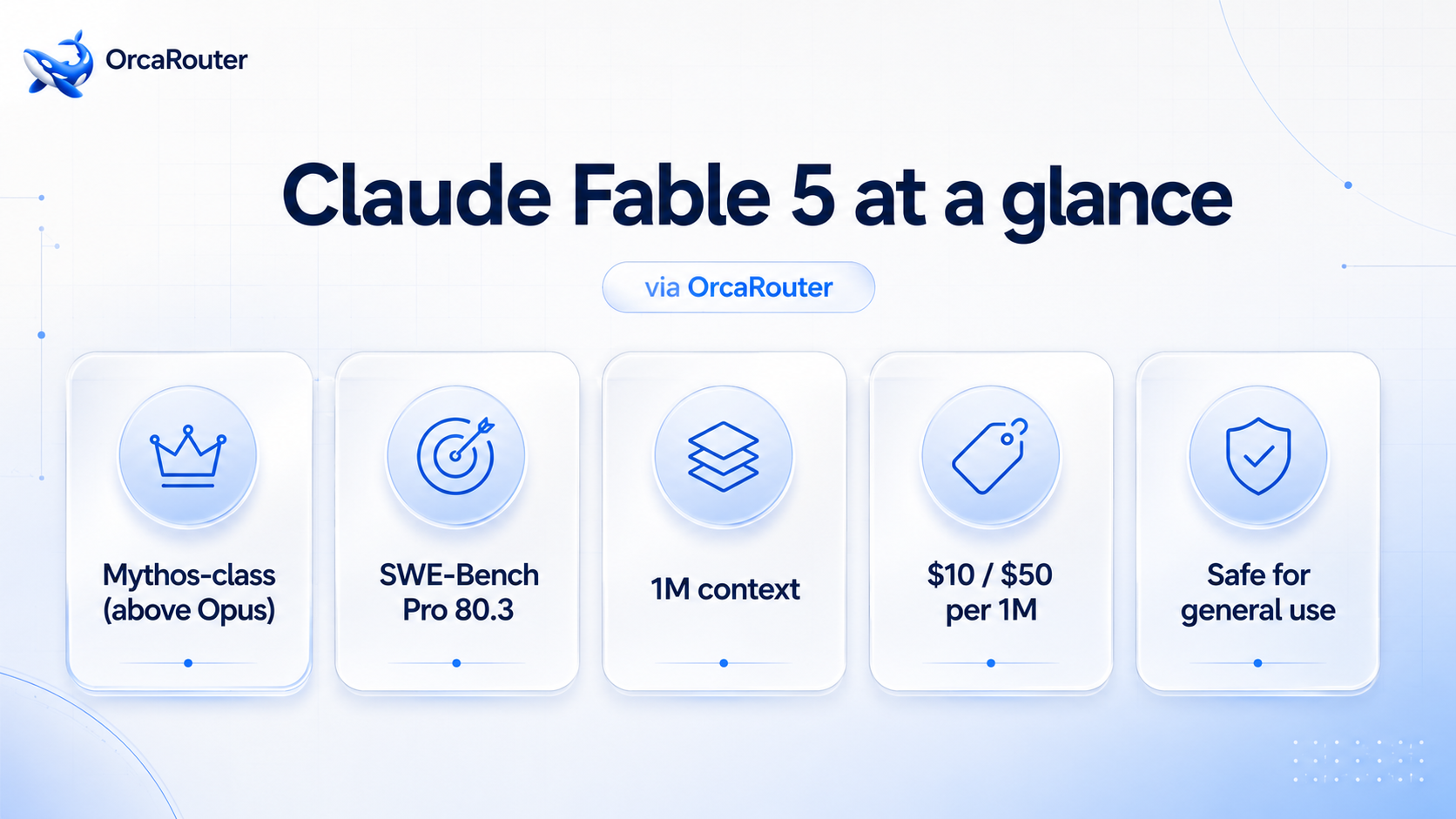
Most model launches are incremental. Claude Fable 5 is not: Anthropic positions it as a 'Mythos-class' model — a capability tier above the Opus class — made safe for general use. Its results are state-of-the-art across software engineering, knowledge work, vision and research, and the pitch is simple: the longer and harder the task, the more its lead widens. That ceiling comes at a premium price of $10 / $50 per million tokens.
If you want to build on it, you can go direct to Anthropic, or reach it through a model aggregator such as OrcaRouter, which exposes Claude Fable 5 through a standard OpenAI-compatible endpoint. Either way, here's what to know.
TL;DR — Anthropic's top 'Mythos-class' tier, above Opus. 1M context, 128K output, text + image + file, adaptive reasoning. $10 / $50 per million tokens. Highest ceiling Anthropic ships — SWE-Bench Pro ~80.3, OSWorld-Verified 85 — best reserved for the hardest, longest tasks.
Claude Fable 5 at a glance
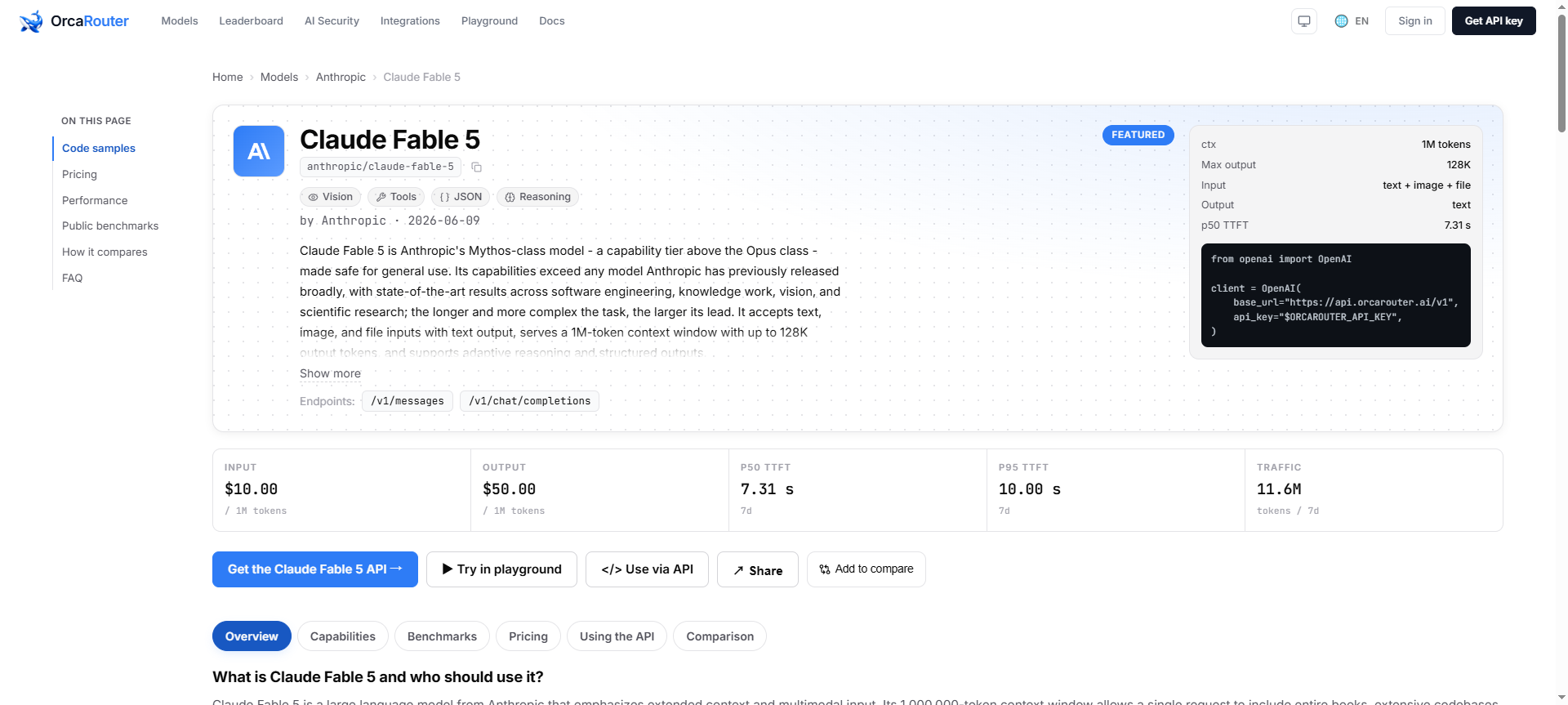
- Developer: Anthropic — model id anthropic/claude-fable-5
- Released: June 9, 2026 (a capability tier above Opus)
- Context: 1,000,000 tokens; up to 128K output
- Inputs: text, image and file; adaptive reasoning and structured outputs
- Price: $10 / 1M input, $50 / 1M output
- Built for: the hardest software engineering, deep research and long-horizon agentic work
Why Claude Fable 5 is different
Fable 5 is aimed at the frontier of difficulty. Where most models plateau, its lead grows: on long, multi-step engineering and research tasks it holds coherence and quality that cheaper tiers can't match, which is exactly what 'a tier above Opus' is meant to signal.
It's multimodal and long-context — text, image and file input over a 1M window — so it can take on a whole repository, a full research corpus, or a design-plus-spec and carry the job end to end.
It's also the safe-for-general-use build of Anthropic's Mythos tier: extra safety checks run under the hood, which is why a small number of borderline prompts get extra scrutiny.
Benchmarks: built for the hardest tasks
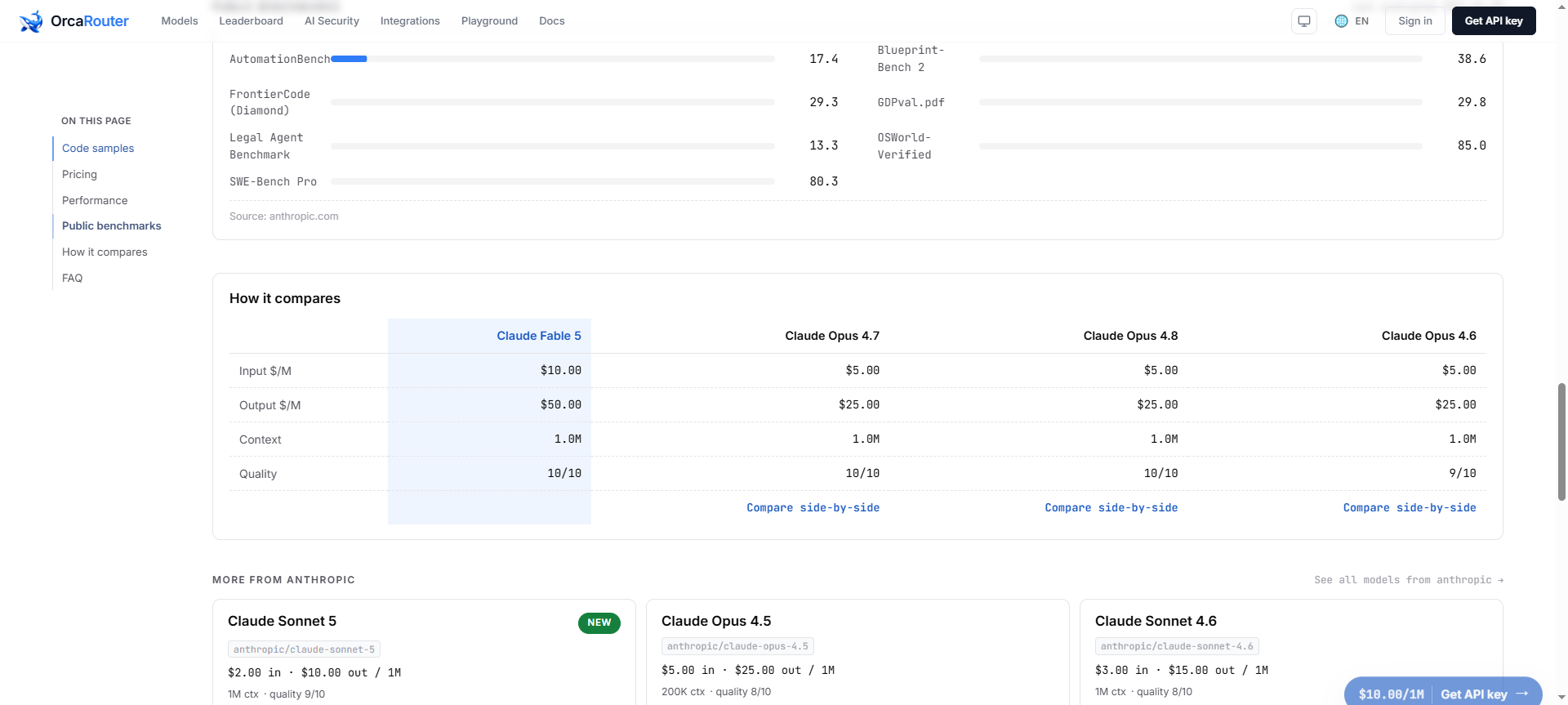
Fable 5's numbers are strongest exactly where difficulty is highest. On Anthropic's reported results it posts SWE-Bench Pro around 80.3 and OSWorld-Verified 85.0 — leading marks for real-world software engineering and computer-use tasks — and it's rated top-tier (10/10) for overall quality on aggregator comparisons.
As with any launch numbers these are vendor-reported, so benchmark them on your own hardest workloads — which is precisely where Fable 5 is designed to pull ahead.
The short version: Fable 5 is the model you escalate to when a task is too hard, too long, or too important for anything else.
Pricing
At $10 / $50 per million tokens, Fable 5 is Anthropic's premium tier — double the Opus rate — because it targets work where a better answer is worth more than a cheaper one.
Model | Input / 1M | Output / 1M | Quality |
Claude Fable 5 | $10.00 | $50.00 | 10/10 |
Claude Opus 4.8 | $5.00 | $25.00 | 10/10 |
The economical way to use it is as an escalation path: send the genuinely hard jobs to Fable 5 and route everything routine to a cheaper model, all from one endpoint. Pay-per-token API access also means you're not tied to whether it's in a given subscription plan that week.
How to access the API
If your code already speaks the OpenAI format, switching is a two-line change, not a rewrite — point the base URL at the provider and set the model string:
from openai import OpenAI client = OpenAI( base_url="https://api.orcarouter.ai/v1", api_key="$ORCAROUTER_API_KEY", ) response = client.chat.completions.create( model="anthropic/claude-fable-5", messages=[{"role": "user", "content": "Hello"}], ) print(response.choices[0].message.content) |
Because the endpoint is OpenAI-compatible, you can call Fable 5 from the OpenAI SDK, LangChain, Cursor or Cline, and keep a cheaper default configured alongside it — escalation is one model-string change.
Getting the most out of Claude Fable 5
A capable model rewards a bit of discipline. Be explicit in your prompts about format, constraints and what a good answer looks like — precise instructions beat vague ones and cut the expensive retries that quietly inflate a bill. And match effort and context to the job: a tighter, well-scoped prompt is usually faster and cheaper than dumping everything into a giant context window just because you can.
It also pays to think in tiers instead of using one model for everything. Route the routine bulk of your traffic to a cost-effective option and reserve Claude Fable 5 for the requests that genuinely need it. Because the endpoint is OpenAI-compatible, that routing is a configuration choice rather than a rewrite, so you can tune the cost/quality balance without touching application code.
Finally, keep a small evaluation set of your own real prompts and re-run it whenever you weigh a new model or setting. Public benchmarks are a useful starting point, but the only scores that matter are the ones on your own tasks — and testing a challenger is a one-line model-string change, so there's little reason not to measure before you commit.
Who should use it — and who shouldn't
Reach for it when: the task is at the edge of what any model can do — repo-scale engineering, deep multi-step research, long-horizon agents — and a better outcome justifies the premium.
Look elsewhere when: the work is routine or cost-sensitive. For everyday tasks a mid-tier model delivers most of the value for a fraction of the price; keep Fable 5 for the jobs that actually need it.
FAQ
Why did Fable 5 disappear for a while, and can I use it now?
It was export-controlled shortly after launch and unavailable for roughly 19 days, then redeployed — which is why the timeline confused everyone. It's available again through the API today; calling it per-token means you're not dependent on whether it's in a given subscription plan that week.
Why does Fable 5 keep handing me off to Opus 4.8, and how do I stop it?
Its safety classifier is jumpy and sometimes false-positives on ordinary work, falling back to Opus mid-task. The fix heavy users share: don't retry the same prompt in the same chat — that keeps tripping the classifier. Rephrase the request neutrally, or start a fresh chat.
How do I avoid wasting Fable 5's expensive tokens?
Two habits from people who use it daily: give it one big, complete brief instead of many small back-and-forth messages (it's built for long-horizon work), and skip the small talk — every extra turn makes it re-read the whole conversation at its premium rate.
Is Fable 5 worth it over Opus 4.8, or just 'Opus in a mask'?
Used like Opus on routine tasks, it's overkill and the difference is hard to feel — hence the meme. Its lead shows on genuinely hard, long jobs: architecture reviews, gnarly multi-file refactors, research synthesis. Reserve it for those and route everyday work to a cheaper model.