AI in Construction Estimating Services: How Automation Is Changing Cost Accuracy
Artificial intelligence is redefining how manufacturing initiatives are expected to be. As material fees fluctuate, tough work fees develop, and undertaking timelines become more complex, conventional estimating methods are not sufficient to preserve accuracy. Manual spreadsheets and time-consuming calculations frequently lead to errors, delays, and economic overruns that might have an effect on venture profitability.
With the expertise of a Construction Estimator, today, AI in manufacturing estimating services is reworking the manner in which contractors, builders, and estimators prepare project budgets. Instead of relying absolutely on guide calculations, AI-powered systems observe historical undertaking statistics, actual-time pricing, and predictive fashions to deliver quicker and more correct estimates.
This shift towards manufacturing estimating automation is helping introduction groups to reduce threats, improve bidding accuracy, and make statistics-driven alternatives at some stage in the challenge lifecycle. As AI technology continues to evolve, it is turning into an important tool rather than a non-compulsory advantage.
What Is AI in Construction Estimating?
AI construction estimating refers to the use of artificial intelligence, machine learning, and data analytics to automate and enhance the project-estimating process. Rather than manually reviewing drawings, calculating quantities, and getting to know material expenses, AI-powered software plays the role of using sensible algorithms.
Traditional estimating relies closely on the estimator's experience and subjective reality entry. AI-driven systems observe lots of preceding initiatives, market dispositions, and charge databases to generate relatively accurate estimates in minutes in construction estimation services.
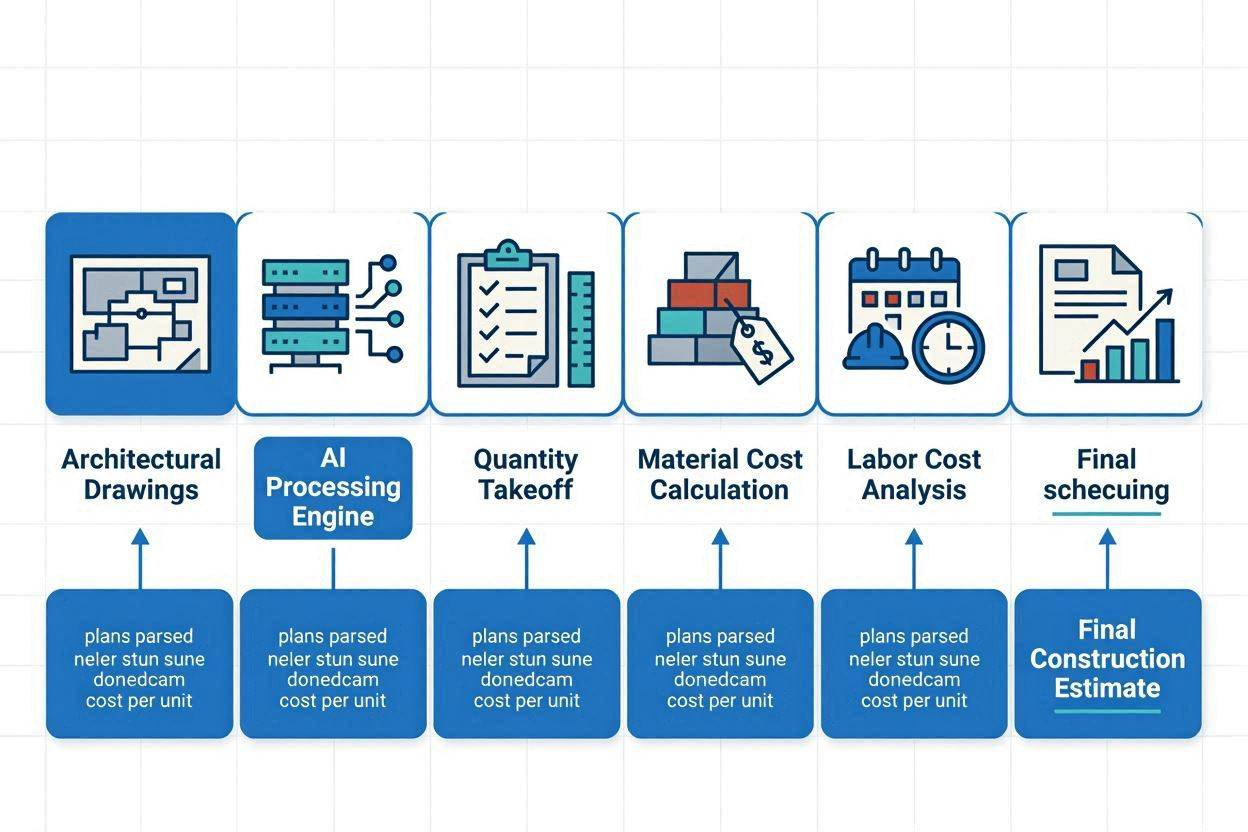
Modern computerized fee estimation structures can:
- Generate quantity takeoffs
- Predict hard work and fabric expenses.
- Compare the estimate with historical tasks.
Many structures, moreover, integrate with Building Information Modeling (BIM), allowing estimators to work from virtual models in lieu of static drawings.
How AI Improves Construction Cost Accuracy
With the support of CAD Services, one of the most important reasons construction tasks exceed the budget is wrong estimation. Small calculation errors, outdated pricing, or missing portions can fast become expensive issues at some point in the future in construction.
Construction charge accuracy AI addresses these problems through practical statistical analysis and automation.
AI improves estimating accuracy with the aid of the following:
- Using real-time pricing databases instead of antique charge books
- Detecting inconsistencies in task estimates
- Comparing new estimates with the masses of preceding obligations
Predictive analytics additionally facilitates estimators to count on market inclinations earlier than bids are submitted. If steel costs or difficult painting charges are expected to grow, AI systems can recommend pricing modifications that better defend contractors' profit margins.
Additionally, AI constantly learns from completed responsibilities. Every completed assignment improves the tool's potential to estimate future artwork more accurately. Here is the comparison structured as a clean, easy-to-read calculation table:
Cost Optimization Analysis
Cost Item | Traditional Estimate | AI-Optimized Estimate | Savings (Difference) | % Saved |
Labor | $120,000 | $116,500 | -$3,500 | 2.9% |
Structural Steel | $82,000 | $80,500 | -$1,500 | 1.8% |
Equipment | $42,000 | $41,000 | -$1,000 | 2.4% |
Concrete | $48,000 | $47,200 | -$800 | 1.7% |
Electrical | $38,000 | $37,200 | -$800 | 2.1% |
Plumbing | $29,000 | $28,400 | -$600 | 2.1% |
Total Project Cost | $359,000 | $350,800 | -$8,200 | 2.3% |
Key Insight: The categories are sorted from highest savings to lowest. While Labor yields the largest single dollar amount saved ($3,500), the Labor and Equipment categories represent the highest percentage efficiency gains for the project.

Key Technologies Behind AI Estimating Systems
The present-day AI estimating technology combines several advanced technologies that work together to automate construction estimating.
Machine Learning in Construction Estimation
A machine gaining knowledge is one of the best advantages of AI estimation.
Unlike traditional software packages that follow constant tips, system-studying estimating structures constantly improve with the resource of gaining knowledge from ancient venture statistics.
Machine learning analyzes:
- Previous assignment costs
- Material usage
- Labor productivity
Over time, the systems recognize patterns that human estimators might likely forget. For instance, they can predict how weather situations, construction type, or venture period affect construction prices.
As more tasks are completed, predictive analytics turn out to be increasingly more correct, permitting contractors to make smarter bidding picks.
BIM Integration in Cost Estimation
Building Information Modeling (BIM) offers the digital foundation for many AI-powered estimating structures.
Instead of estimating from 2D drawings, BIM fee estimation makes use of smart 3D models containing specific project data.
BIM integration lets AI:
- Automatically calculate material quantities
- Update estimates on every occasion that designs are exchanged.
- Detect conflicts among building structures.
Because BIM models contain enormously specific construction facts, AI can generate estimates a whole lot quicker while lowering human errors.
AI Tools Used in Construction Estimating
Numerous software program structures now encompass AI and automation in manufacturing estimating workflows.
Some of the leading AI construction estimating software programs include the following:
Here is the structured features table with your values neatly organized:
Software | Primary Features |
Bluebeam | Digital plan evaluation, markup, and amount takeoffs |
PlanSwift | Automated takeoffs, fabric calculations |
Autodesk Construction Cloud | BIM integration, estimating workflows, collaboration |
STACK | Cloud estimating, virtual takeoffs, bid management |
ProEst | AI-assisted estimating, reporting, and databases |
CostX | Quantity surveying, BIM integration, and estimating automation |
These structures integrate automation with cloud generation, permitting challenge teams to collaborate from more than one place while retaining regular venture statistics.
Benefits of AI in Construction Estimating Services
Benefit | How AI Improves Construction Estimating |
Greater Cost Accuracy | Reduces manual errors by using intelligent algorithms, historical data, and automated calculations to produce more precise estimates. |
Faster Estimating | Completes quantity takeoffs and cost estimates in hours instead of days, helping contractors meet tight bidding deadlines. |
Improved Bid Competitiveness | Enables contractors to prepare more accurate and profitable bids, increasing their chances of winning projects. |
Real-Time Pricing | Uses up-to-date material, labor, and equipment pricing instead of outdated cost databases or pricing manuals. |
Reduced Project Risk | Identifies missing scope items, calculation errors, and potential cost overruns before bids are submitted. |
Higher Productivity | Automates repetitive estimating tasks, allowing estimators to focus on project analysis, strategy, and client communication. |
Better Decision-Making | Leverages predictive analytics and historical project data to support smarter budgeting and project planning decisions. |
Consistent Estimating Standards | Standardizes estimating processes across teams, improving consistency, quality, and reliability in project estimates. |
Improved Collaboration | Cloud-based platforms enable estimators, project managers, and clients to access and update the same project information in real time. |
Seamless Integrations | Connects software packages, version control structures, scheduling systems, and supplier pricing databases via APIs. |
Challenges and Limitations of AI Estimation
Challenge | Description |
Data Quality | AI relies on accurate historical project data to generate reliable estimates. Poor-quality or incomplete data can lead to inaccurate predictions and cost estimates. |
Implementation Costs | Adopting advanced AI estimating software may require a significant investment in software licenses, employee training, infrastructure, and system integration. |
Employee Training | Estimators need training to understand AI-generated insights, validate recommendations, and effectively use new estimating technologies. |
System Integration | Integrating AI software with existing accounting systems, BIM platforms, ERP solutions, and project management tools can be complex and time-consuming. |
Human Oversight | AI cannot fully understand every unique project condition or client requirement. Experienced estimators remain essential for reviewing assumptions, validating estimates, and applying professional judgment. |
Future of AI in Construction Cost Estimation
The future of automation inside the construction industry is turning increasingly clever.
Emerging technology will keep increasing AI's abilities beyond ultra-modern estimating approaches.
Expected traits embody the following:
- Generative AI creates complete mission estimates from layout standards
- Digital twins present real-time price forecasting for the duration of construction
- Robotics is gathering difficult information for automatic estimate updates
- AI-powered procurement pointers
Material | Current Price | Predicted Increase | Price Hike Amount | Future Cost |
Steel | $80,000 | 6% | +$4,800 | $84,800 |
Concrete | $46,000 | 3% | +$1,380 | $47,380 |
Lumber | $24,000 | 5% | +$1,200 | $25,200 |
Copper | $18,000 | 8% | +$1,440 | $19,440 |
--- | --- | --- | --- | --- |
Total | $168,000 | — | +$8,820 | $176,820 |
As cloud computing and artificial intelligence improve, estimating structures emerge as quicker, more accurate, and increasingly linked to every segment of the supply chain.
With the help of Construction Estimating Services, rather than honestly generating estimates, future AI systems will continuously display venture charges and recommend changes throughout the introduction.
Conclusion: Is AI Replacing Human Estimators?
The upward push of AI in construction estimation services is reworking the development industry by improving velocity, consistency, and value accuracy. Automation reduces repetitive obligations, analyzes tremendous quantities of undertaking statistics, and supports more knowledgeable bidding picks. However, AI isn't always replacing skilled estimators—it's miles ahead in enhancing their capabilities.
The maximum achievement of construction companies is adopting a hybrid approach that mixes wise automation with human understanding. AI excels at processing statistics, identifying tendencies, and producing rapid estimates, while professional estimators offer essential critical thinking, mission-unique judgment, and customer-targeted decision-making
As AI generation continues to mature, advanced companies that embody automation while investing in expert estimating experts may be better positioned to deliver correct bids, control mission expenses, reduce economic risk, and stay competitive in an increasingly information-driven industry.
FAQs About AI in Construction Estimating
What is AI in manufacturing estimating?
AI in estimating uses artificial intelligence, system studying, and predictive analytics to automate quantity takeoffs, fee calculations, and undertaking budgeting.
How correct is the AI fee estimation system?
AI equipment can extensively enhance estimating accuracy by using readings of historical venture data, real-time pricing, and predictive models. However, human assessment stays important for assignment-precise picks.
Can AI replace manufacturing estimators?
No. AI automates repetitive calculations; however, it can't update professional judgment, patron communication, or strategic decision-making. Human estimators stay vital for validating results and handling complicated responsibilities.
Which industries gain the most from AI estimation?
Residential, business, infrastructure, and civil construction projects all gain from AI-powered estimating technologies.
Is AI estimating suitable for small contractors?
Yes. Many cloud-based estimating structures provide scalable solutions that assist small and medium-sized contractors in improving performance without maintaining massive estimating departments.